How to track AI traffic from ChatGPT and AI Overviews

If you run a small business or handle its marketing, you've started wondering whether anyone finds you through ChatGPT, and the answer isn't anywhere obvious. Search Console's AI report gives you impressions with no clicks, no queries, and no way to tell whether any of it turned into a phone call. This covers what you can measure instead and what to do with it.
To track AI traffic, stop waiting on Google and read it out of your own analytics instead. Two numbers are within reach: AI-assistant referrals, which land in Google Analytics 4 as a named traffic source, and whether assistants mention your business at all when a customer asks. Judge both by conversions, because the visit counts will always look small.
The generative AI performance report
The generative AI performance report in Search Console rolled out to every site worldwide on August 31, 2026, and it counts impressions in AI Overviews and AI Mode by page, country, device and date. That is the whole of it. Google's own help page says plainly that "it's common to have impressions without clicks."
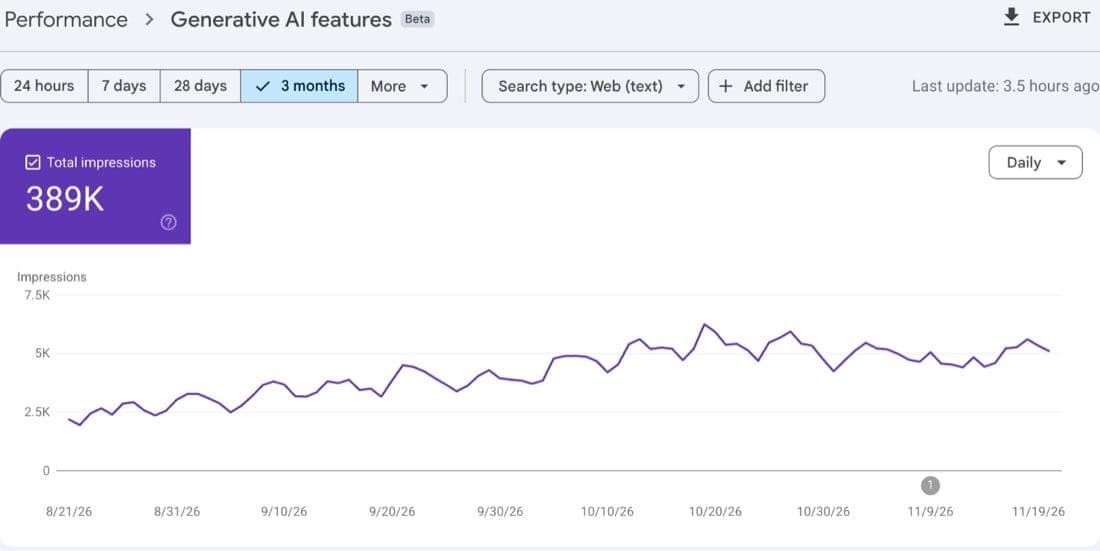
The Pages tab is the part worth your time, because it tells you which of your pages Google is pulling into AI answers. That's a content signal you can act on even with no clicks attached.
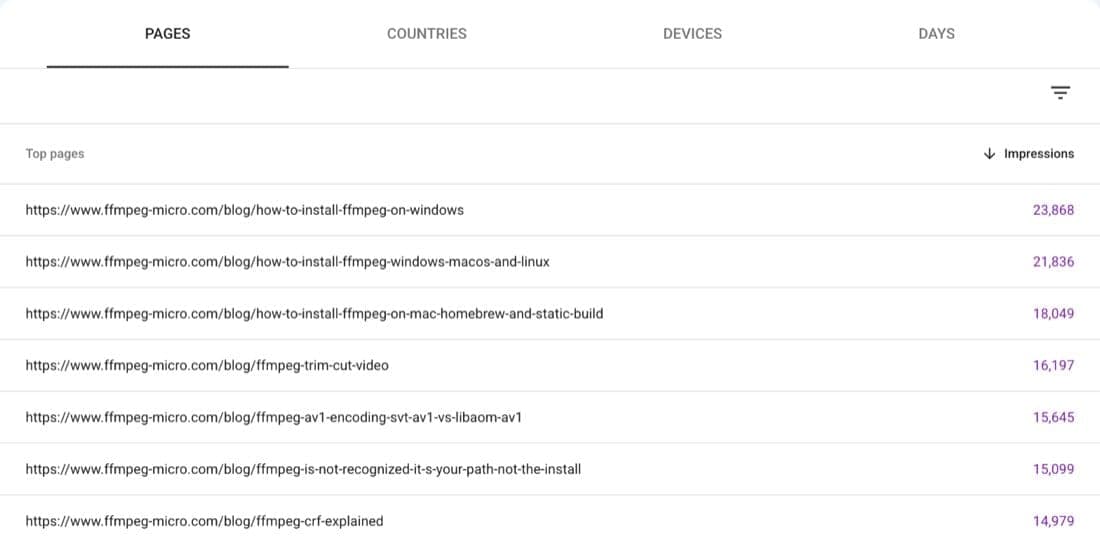
The clicks from those appearances do exist, and they land in your overall search traffic under the Web search type in the main Performance report, where Google's search blog confirms you can't pull them apart from ordinary blue-link clicks.
Anyone waiting for that to change got an answer on November 2, 2026, when Gary Illyes, a longtime Google Search staffer who speaks for the company at industry events, said the team is "super interested in giving more data" but that Google has "nothing to announce" on clicks and queries for AI Mode and AI Overviews, as reported by Search Engine Roundtable. John Mueller, another Google Search spokesperson, then called one widely shared reading of the comment weird, so even the direction is unsettled. Treat the impression number as background, and never report it to yourself as a result.
The December 3 deadline
The December 3, 2026 date circulating among SEO consultants is a UK remedy, not a feature announcement. The Competition and Markets Authority's publisher conduct requirement obliges Google, under its strategic market status designation, to give publishers impressions, clicks and click-through rate for generative AI features, separated out from Search as a whole. The first compliance report covers June 3 to December 3, 2026 and is due January 3, 2027.
Read who that remedy is for. It binds Google toward UK publishers. Nothing in the CMA's final decision promises a plumbing company in Ohio a clicks column in its Search Console. Plan as though that data never arrives, and spend your time on the two numbers you own.
AI-assistant referrals in your analytics
A visit from ChatGPT, Perplexity or Claude is a real session with a real referrer, and GA4 has sorted those into a native AI Assistant channel since May 2026. Google's channel documentation explains that the medium is set to ai-assistant when the referrer matches a known assistant list, and that Google's own AI Overviews and AI Mode are excluded and stay in Organic Search. Four steps get you to a usable number, and the third is the one most people skip.
The AI Assistant channel
In GA4, open Reports, then Acquisition, then Traffic acquisition, and look for AI Assistant in the default channel group. If the row isn't there, nobody has arrived with an assistant referrer attached in that date range.
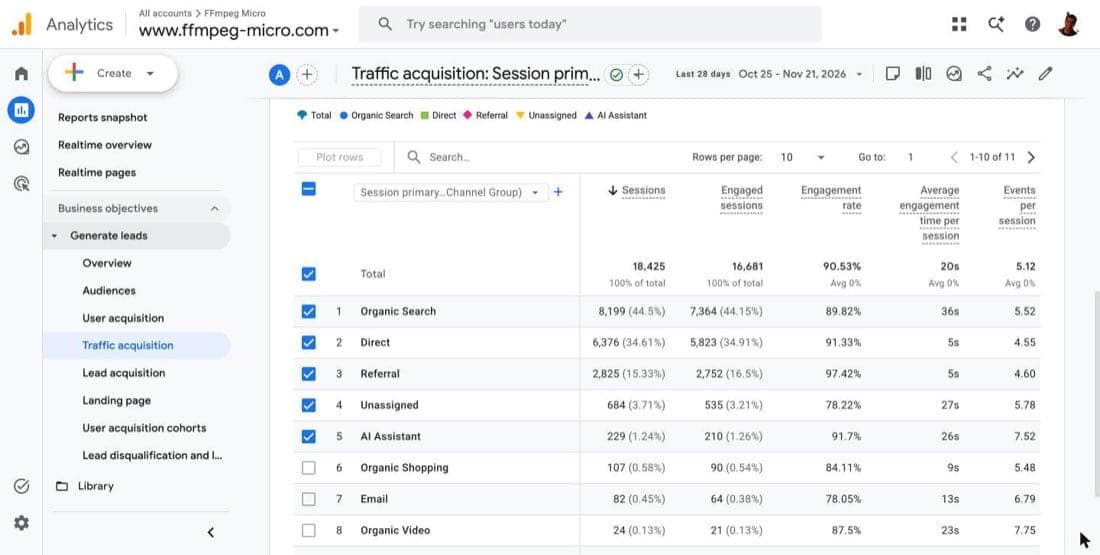
The split by assistant
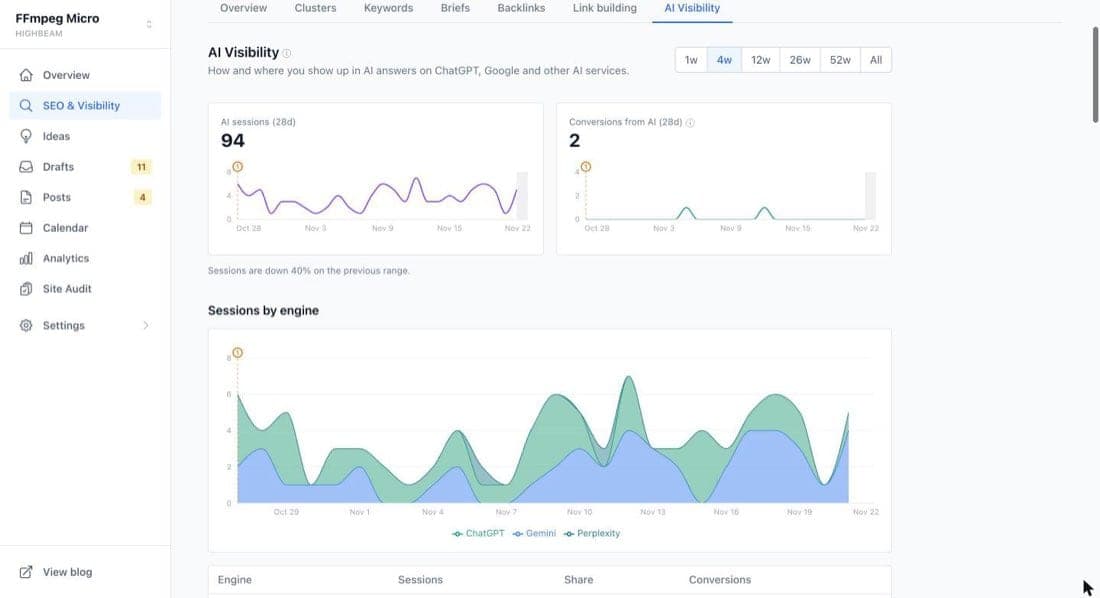
Add Session source as a secondary dimension so each assistant gets its own line. On the site above, chatgpt.com, gemini.google.com and claude.ai sent nearly all of it, with perplexity.ai far behind, and knowing which assistant likes you tells you which one to check your answers in first.
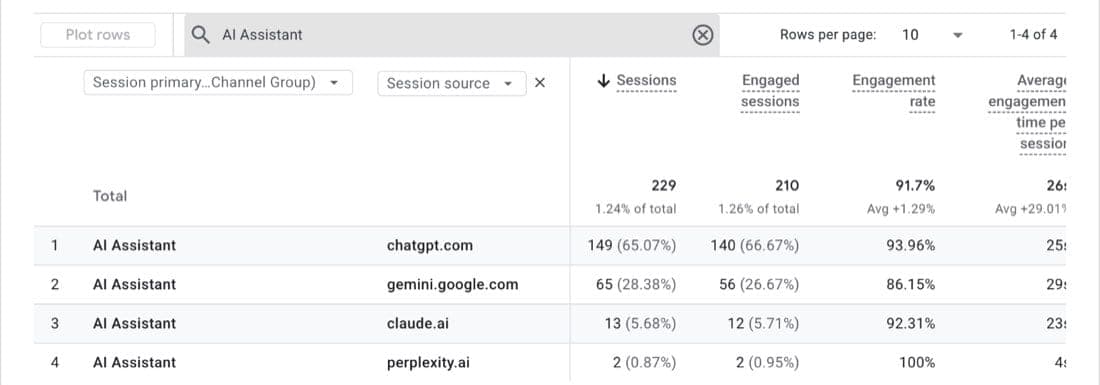
A source-only channel group
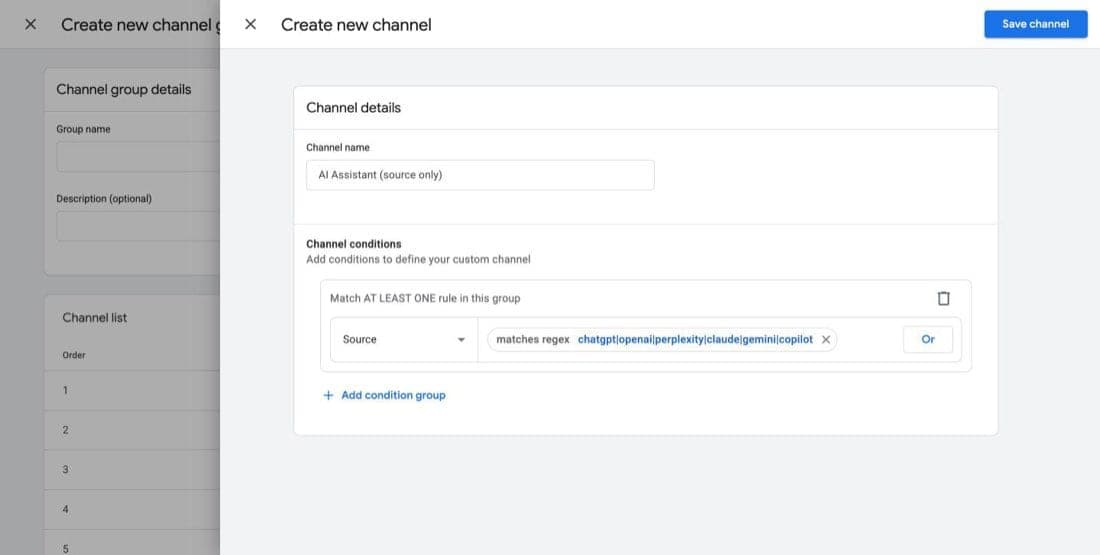
Build a custom channel group in Admin that matches on session source alone, not on source and medium together. Search Engine Journal showed that the native channel undercounts because assistant apps and in-app browsers strip the medium, splitting one source across AI Assistant, Referral and Unassigned. A source-only group collapses them back together, and it applies retroactively across your whole date range, so you get a corrected history the moment you save it.
Key events
Decide what counts as a conversion for your business and mark each one as a key event: a contact form sent, a tap on your click-to-call link, a booked appointment or demo, a signup. Until you do that, an assistant referral is a session and nothing more, and a session is not a number you can make a decision with.
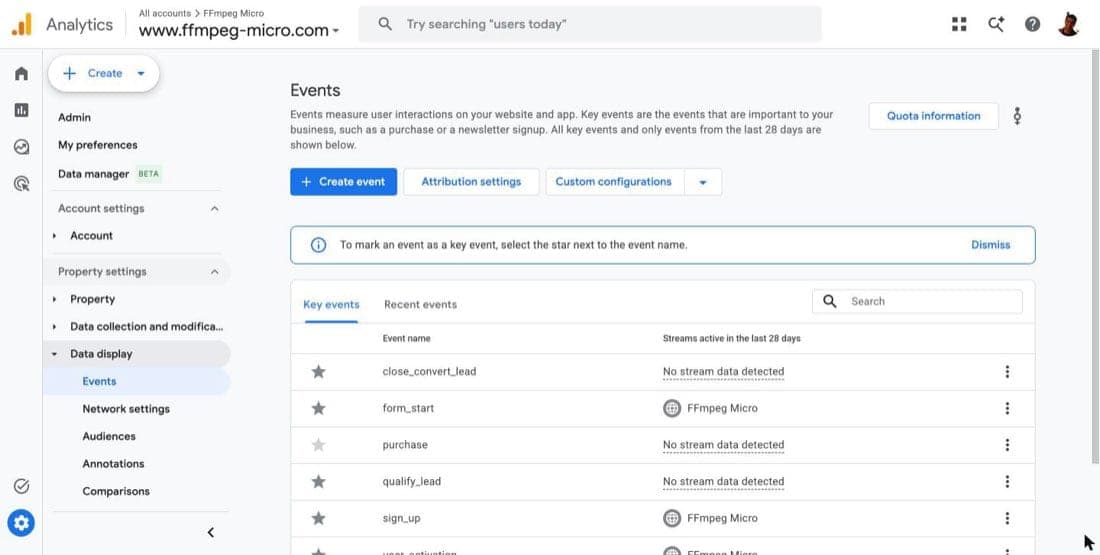
That number breaks sometimes, and it's worth knowing the shape of it. Around October 7 and 8, 2026, after the GPT-6 rollout, ChatGPT stopped passing its referrer and its utm_source=chatgpt.com tag, and ChatGPT-attributed GA4 sessions fell between 22% and 57% on tracked sites while Direct rose. OpenAI confirmed the bug on October 14 and had tagged clicks back to roughly 95% to 100% of baseline by October 15. So when your ChatGPT referrals drop to zero one week, check whether the platform changed before you tear up your site.
The citation check
Referrals miss most of what AI assistants do with your business, because an assistant that names you and reads out your phone number produces no session at all. Brodie Clark, an SEO consultant who tracks the changes Google makes to its search results, spotted Google testing the removal of the citation cards beside AI Overviews in late October 2026, which would narrow the visible path back to your site further still.
So check the citations yourself. Write down the ten questions your customers actually ask, the ones with your town's name in them, and put each one to ChatGPT, Gemini, Claude and Perplexity. Record three outcomes per question: named, linked, or passed over for someone else. Run the same list every week, because these answers shift on their own and a single check only tells you about the day you ran it. Eight weeks of results tell you whether you're gaining ground.
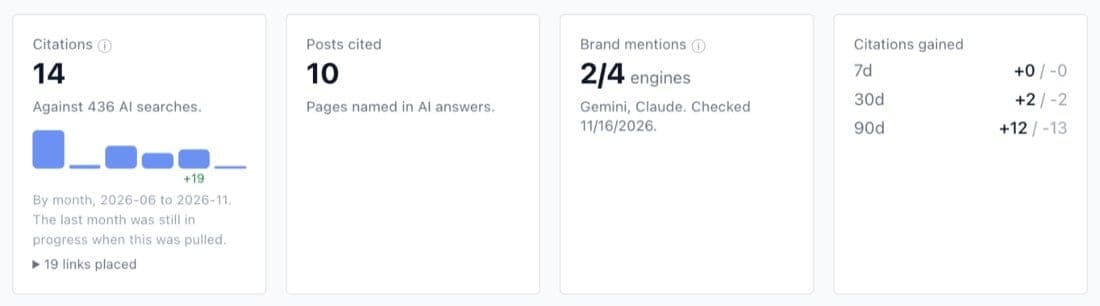
Highbeam, the marketing platform we make for small businesses, does that check on a schedule. Its AI Visibility screen puts its own set of questions to ChatGPT, Gemini, Claude and Perplexity every week, five by default, written from what the business says it does and sells, and editable by the owner. Because it's the same set each week, the result reads as a trend rather than a snapshot, and the AI-assistant visits and conversions sit on the same screen as the mentions.
A month at a one-location HVAC company
Take a single-location HVAC company with a modest blog. In a month it records 2,400 sessions. Organic search is 1,180 of them. The native AI Assistant channel shows 31. The source-only channel group finds another 14 chatgpt.com sessions sitting in Referral and Unassigned, so the real figure is 45.
Forty-five visits out of 2,400 looks like noise, and the instinct is to ignore it. The conversion rate is the reason not to.
| Who | What they found |
|---|---|
| One site running on Highbeam, November 2026 | AI-assistant visitors convert at about 5%, Google search visitors at about 1% |
| Ahrefs, on its own site | AI search was about 0.5% of visits and about 12.1% of signups |
| Semrush's AI search traffic study | the average AI search visit is worth about 4.4 times an organic visit on conversion rate |
At those rates, the HVAC company's 45 AI-assistant sessions produce about 2 leads and its 1,180 organic sessions about 12. That's the line to put in your monthly report: 2 leads from AI assistants, 12 from Google search, this month. Under 2% of all visits, about a seventh of the leads.
Which gives you the one thing to do with all of this. Decide what counts as a conversion for your business, mark every one of them, and tie each conversion back to where the visitor came from wherever your tools will let you. Then stop grading AI by visits. The questions where an assistant named a competitor instead of you are next month's articles, and the conversions by source tell you which questions were worth answering.
Conversion tracking in Highbeam
If you don't want to match visits to calls by hand every month, Highbeam can do it for you. You tell it what counts as a conversion for your business, a form sent, a tap to call, a booked appointment or demo, a signup, and it tracks each one and ties it to where the visitor came from: Google search, an AI assistant, a social post, an email, and the article they read. From there it suggests new content aimed at bringing in more people like the ones who convert, and it reworks the articles that draw visits but no conversions so they do a better job of turning a reader into a call.
If you'd rather not spend a Saturday building channel groups, connect your analytics on the way in, two minutes at signup, and your own conversions by source are waiting for you before the week is out. Try Highbeam free for 7 days; you add a card at signup and we charge you on day 8 unless you cancel before then.
FAQ about tracking AI traffic
Does Search Console show AI clicks?
Search Console does not show AI clicks. The generative AI performance report gives you impressions in AI Overviews and AI Mode with no clicks, no click-through rate and no query data, and the clicks themselves are folded into the Web search type of the main Performance report where you can't separate them out.
Why is my ChatGPT referral traffic showing up as Direct?
ChatGPT referral traffic lands in Direct or Unassigned when the referrer never reaches your site, which happens routinely with the ChatGPT mobile app and in-app browsers, and happened to everyone for a week in October 2026 during the referrer bug. A custom channel group matching on session source alone recovers the sessions that do carry a referrer but lose the medium.
How much AI referral traffic is normal for a small business?
AI referral traffic is a small share of visits almost everywhere. Similarweb measured it at roughly 0.3% across 101,574 sites in April 2026 and 0.28% across 74,752 sites in March 2026, so a two-figure session count in your report is the normal result, not a broken tag.
How do I track traffic from AI Overviews?
Traffic from AI Overviews can't be isolated. Those clicks arrive as ordinary organic search sessions in GA4, Google's AI Assistant channel explicitly excludes AI Overviews and AI Mode, and Search Console gives you the impression count with no click attached to it.
Which numbers should I check every month?
Check three numbers every month: AI-assistant sessions and the conversions they produced, organic search sessions and the conversions they produced, and the share of your customers' real questions where an assistant named you. The AI impression count from Search Console goes at the bottom, since you can't tie it to a single phone call.
About Javid Jamae
Founder at Highbeam
Javid Jamae builds Highbeam, and his own portfolio of businesses runs its entire marketing operation on it: research, content, search and AI visibility, and the reporting that ties them to revenue. The numbers and failures in these posts come from systems he operates himself. Before that he led experimentation and growth engineering at Postman, Achieve and Earnest, shipping roughly 150 product experiments and the infrastructure under them.
You might also like

See what Highbeam finds on your site
A free site audit and first-pass content strategy, from your site alone. Business email required.
Get your free site audit